
Madison County Projected Release Meaning
A projected date is an estimate, not the completed release record. TDCJ defines Projected Release Date as the date set by Correctional Institutions Division Classification and Records for projected exit from incarceration if parole does not occur sooner. The offense title, offense date, sentence, credit rules, mandatory-supervision eligibility, and later Board action can affect it.
A scheduled release date appears at a later processing stage. After the required certificate and file review, the public detail may show Scheduled Release Date, Type, and Location. TDCJ warns that a scheduled date can change. The actual release is the completed custody event documented by agency records.
- Projected date
- A computed estimate under sentence-credit and release rules.
- Scheduled date
- A planned date shown after release processing advances.
- Parole eligibility
- The point when discretionary review may become possible, not release approval.
- Discharge
- Completion of the sentence and any related parole, mandatory supervision, or community-supervision duty.
Find Madison County Projected Dates
Choose the search route by custodian. A person in Madison County Jail may be awaiting trial, serving a short sentence, or waiting for transfer. The county roster has no projected-release field. A person at Jim Ferguson Unit is in TDCJ, even though the prison is physically in Madison County. The statewide offender search is the proper route for that sentence.
- Confirm whether Madison County Jail, TDCJ, another county, BOP, or ICE holds the person.
- For TDCJ, search by seven-digit TDCJ number or SID number when available.
- Open the detail and separate projected, eligibility, maximum, and scheduled fields.
- For a county sentence, obtain the judgment and ask the jail about the official calculation.
- Check all court orders, holds, warrants, and receiving-agency records.
- Confirm the planned event again before pickup or travel.
Use the TDCJ Online Inmate Search only for current TDCJ incarceration. It is updated on working days and is at least 24 hours old. It does not retain released people as a released-result archive. The Madison County release search supplies the records path after a person leaves a live roster.
TDCJ Projected Release Search Fields
The statewide search accepts exact last and first name, TDCJ number, SID number, gender, and race routes. A number is safer than a common name. Results list the name, TDCJ number, race, gender, projected release date, unit assignment, and age. Open the detail to compare identity, offense, sentence, maximum date, current facility, parole eligibility, and scheduled fields when present.
| TDCJ field | Correct reading |
|---|---|
| Current Facility | The present assignment shown by TDCJ, subject to update timing |
| Projected Release Date | A calculated estimate, often tied to maximum expiration or mandatory-supervision rules |
| Parole Eligibility Date | When review may legally become possible |
| Maximum Sentence Date | The maximum-expiration reference shown for the sentence record |
| Scheduled Release Date/Type | Later-stage release processing fields |
| Scheduled Release Location | The planned release site, which may differ from the current unit |
A blank or missing scheduled field does not prove denial. The case may not have reached scheduling. A no-result after release does not prove full discharge because parole or mandatory supervision may continue outside prison.
Texas Has No 85-Percent Rule
Texas does not impose one general requirement that every prisoner serve 85 percent of a sentence. Applying that percentage to a Madison County or Ferguson case would be false. Texas calculations vary by offense, offense date, sentence, good-conduct classification, parole statute, and mandatory-supervision eligibility.
Under Government Code Chapter 498, good-conduct time affects eligibility for parole or mandatory supervision but does not otherwise shorten the sentence. It is a privilege, not a right. Section 498.003 describes classification-based accrual, including different rates for certain trusty and class levels, while disciplinary rules can cause forfeiture.
For ordinary parole eligibility, Government Code Section 508.145 commonly uses calendar time plus accrued good time equal to one-fourth of the sentence or 15 years, whichever is less, subject to exceptions. Cases involving offenses or findings listed through Article 42A.054 commonly require actual calendar time equal to one-half of the sentence or 30 years, whichever is less, with good time excluded from that threshold. Eligibility opens review; it does not command release.
Madison County Mandatory Supervision Dates
Mandatory-supervision rules add an offense-date and eligibility layer. For eligible offenses before September 1, 1996, calendar time plus good time equaling the sentence produces the projection unless parole occurs sooner. For eligible offenses on or after that date, the same credit equation is also subject to discretionary Board review. A denial of discretionary mandatory supervision can move the projected date to maximum expiration.
Government Code Sections 508.147 and 508.149 govern core eligibility and exclusions. Some convictions and findings are ineligible. In post-1996 discretionary cases, the Board may deny release under the statutory findings and later reconsider as applicable. Offense date controls which law applies, so a current statute summary cannot replace review of the actual sentence file.
A prisoner who leaves confinement on mandatory supervision has been released from prison but has not necessarily discharged the sentence. The Parole Division confirms the supervised status and later discharge. That distinction explains why a gate date and a sentence end date can be years apart.
Why Madison Release Dates Change
Every displayed date rests on facts that can change or be corrected. A new court order can alter the sentence. A disciplinary action can affect good-conduct credits. A detainer can change the receiving custodian or release site. Parole and mandatory-supervision decisions can move the path earlier or later. Release prerequisites and file audits can also affect scheduling.
| Factor | Possible effect | Confirm with |
|---|---|---|
| Good-time forfeiture | Changes a credit-based eligibility or projection | TDCJ Classification and Records |
| Corrected judgment | Changes sentence or credit inputs | Sentencing clerk and TDCJ |
| Parole vote | Authorizes, delays, or denies a conditional path | BPP status and release processing |
| DMS denial | Can move projection to maximum expiration | BPP and TDCJ detail |
| Detainer or hold | Can produce transfer rather than community release | Holding and receiving agencies |
| Release-plan issue | Can delay final scheduling | Review and Release Processing |
Do not infer an actual event from an old screenshot. Save the access time, then confirm the current record.
Madison County Jail Release Dates
A pretrial detainee has no computed prison release date. Release depends on bond clearance, a court order, dismissal, time limits, warrants, and any holds. A bond amount on InteropWeb does not prove that bond was posted or that every hold cleared. Likewise, RELEASED marks the end of the vendor's county booking status but gives no timestamp or reason.
For a sentenced county-jail term, do not apply TDCJ prison good-time tables. Obtain the judgment, sentence, and jail-credit notation, then ask Madison County Jail for its official calculation and the completed release sheet. Local processing can depend on the exact order, credit, warrant status, and operational clearance.
Call 936-348-2755 for a current custody check. For a historical event, request the booking-out sheet, actual date and time, release disposition, authority, custody movement history, and destination. A transfer to TDCJ or ICE ends county custody without ending confinement.
Confirm Madison County Release Scheduling
TDCJ provides an information fallback at pia@tdcj.texas.gov instructions. Include the full name and seven-digit TDCJ number. If the number is unknown, supply the exact birth date or approximate age and county of conviction. TDCJ lists 936-295-6371 and 800-535-0283 for general inmate information.
Classification and Records handles time calculations at 936-437-6231 and classify@tdcj.texas.gov. Before a Board vote, the parole status line is 844-512-0461. After a favorable vote, the cited release-status number is 512-406-5202. Each route answers a different processing stage, so “approved” should not be restated as “released.”
Texas IVSS-Counties can supply a county custody-event alert, while TDCJ Victim Services is the separate prison and parole notification route. Alerts can lag and are not the signed release record. Verify with the custodian on the day of planned travel.
The sentencing court supplies another essential check. A corrected judgment, later order, revocation, amended jail-credit notation, or warrant can change an agency calculation. Madison County misdemeanor matters generally route through the County Clerk, while felony district matters route through the District Clerk. Request the judgment and later orders by case number when possible. A clerk supplies the filed record but does not calculate TDCJ release dates.
If a displayed date conflicts with the judgment, send the authoritative court document to the agency responsible for calculation. Do not ask a roster vendor to resolve a sentence-credit dispute. TDCJ Classification and Records handles state calculations. For a county term, ask the jail and sentencing court to identify the operative order and credit. Keep the disputed display, access time, and response together so the correction trail is clear.
Ferguson Scheduled Release Location
Jim Ferguson Unit is not listed as a routine regional release site. TDCJ may move a person to a regional site based on conviction county, approved residence, or release planning. Special-category male releases identified by TDCJ can occur through Huntsville Unit. The current Scheduled Release Location, not the prior housing unit, controls pickup planning.
TDCJ says releases generally occur from 8:00 a.m. to 5:00 p.m. on weekdays excluding holidays, subject to change. Family pickup is permitted at the actual releasing facility, and statewide instructions describe a bus voucher when bus travel is used. Call the named site before departure. These are state-prison logistics and do not apply to Madison County Jail.
TDCJ Date Definition Source
The official TDCJ inmate-information page shown below explains the agency's projected-date information and limitations.
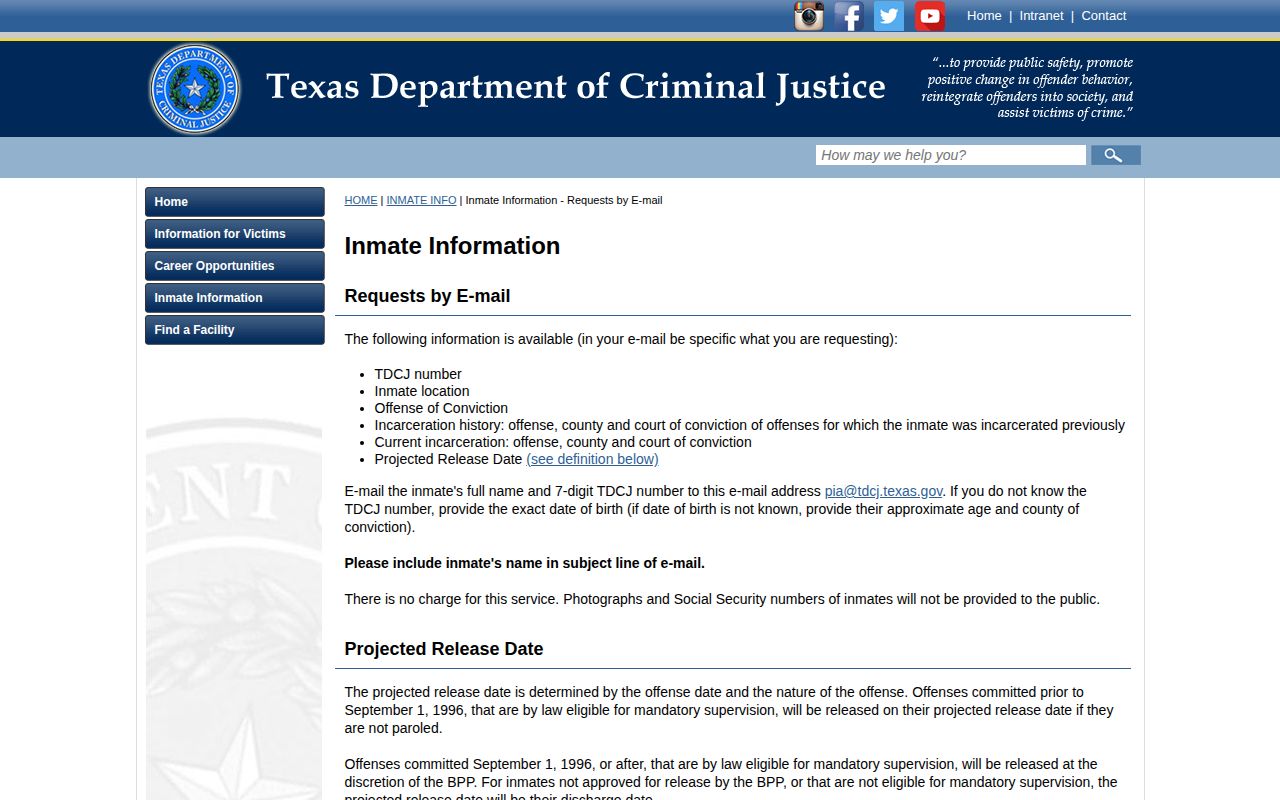
The image identifies the official state channel. It does not show a completed Madison County release and should be paired with the current person-specific record.
Public Record Search
Sponsored Results