
Madison County Parole vs Probation
Parole and mandatory supervision follow incarceration in the Texas Department of Criminal Justice. The TDCJ Parole Division supervises the person in the community, while the Texas Board of Pardons and Paroles makes release, condition, and revocation decisions. Someone leaving Jim Ferguson Unit may therefore be outside prison walls while still serving a state sentence.
Probation is called community supervision in Texas. A court imposes it, and a local Community Supervision and Corrections Department administers it. A person can leave Madison County Jail under a community-supervision order without ever entering TDCJ. The judgment and CSCD record, rather than a parole lookup, establish that path.
| Question | Parole or mandatory supervision | Probation or community supervision |
|---|---|---|
| Who authorizes it? | Texas Board of Pardons and Paroles under the state-sentence process | The sentencing court |
| Who supervises it? | TDCJ Parole Division | Walker, Grimes, Leon and Madison Counties CSCD |
| Best starting record | TDCJ/BPP status and Parole Division records | Judgment or community-supervision order and CSCD verification |
| Proof it ended | Parole, mandatory-release, or discharge record | Court discharge or early-discharge order |
Verify Madison County Post-Release Supervision
Start with the custody and case type, not with a guess based on where the person lives. Madison County contains both a county jail and a large state prison, and their records do not substitute for one another.
- Identify the last system. Use the Madison County InteropWeb record for a county booking and the TDCJ inmate search for a person still in state custody. Released people ordinarily disappear from the TDCJ online search.
- For a TDCJ case, review the current inmate detail's Parole Review Information when available. After release, use the BPP status line, Parole Division public-information route, or assigned district office.
- For probation, obtain the judgment or community-supervision order from the appropriate Madison County clerk. The order establishes the legal term and conditions.
- Call the relevant supervising office to confirm the current assignment. Geographic office maps are a starting point, not proof of an individual's placement.
- For completion, obtain the agency discharge record or court discharge order. Absence from a roster or an absconder list does not establish completion.
TDCJ Parole Division policy identifies potentially available fields including supervising officer, offense, court, cause number, sentence, eligibility, release and discharge dates, supervision status, and warrant number or date. Request only the fields needed for the specific identity and status question.
Madison County Supervision Offices
TDCJ maps Madison County parole to the Huntsville District Parole Office, Region I. An individual may be assigned elsewhere because of residence, special conditions, or case management, so confirm the reporting office rather than relying only on the county cross-reference.
Parole: Huntsville District Parole Office
600 Interstate Highway 45 North
Huntsville, TX 77320
936-295-5217
Fax: 936-435-2603
Community supervision: Madison County CSCD office
101 W. Main Street
Madisonville, TX 77864
Mail: PO Box 985
936-348-2641
Fax: 936-241-6240
The shared CSCD posts general hours of 8:00 a.m. to 5:00 p.m. Monday through Thursday and 8:00 a.m. to 4:00 p.m. Friday. Call before treating those as branch-specific hours. TDCJ's statewide parole status line is 844-512-0461, while BPP's main number is 512-406-5452.
Madison County Violations and Warrants
A “blue warrant” generally indicates a parole or mandatory-supervision violation process. It can return a person to county custody while TDCJ and BPP handle revocation. Madison County InteropWeb records observed during research included parole-warrant and blue-warrant charge language. If that record later says RELEASED, the movement may have been a transfer into TDCJ handling rather than a community release. The jail movement record and BPP outcome answer different parts of the event.
Probation violations proceed through the CSCD and court. A warrant can remain active even when a person is absent from the current jail roster. Likewise, a supervision condition can exist without an active warrant. Present custody, supervision status, and warrant status must be checked separately.
How Madison County Supervision Ends
Parole or mandatory supervision ends through the TDCJ/BPP sentence and discharge process, not simply because a person is no longer in prison. A Parole Division record may show parole or mandatory-release dates, status, and discharge date. The discharge date means completion of the sentence and release from incarceration, parole, mandatory supervision, or community supervision; it is broader than the day someone physically left a prison gate.
Probation completion is best shown by a discharge or early-discharge order from the sentencing court. Depending on jurisdiction, county-level misdemeanor matters generally begin with the County Clerk and felony matters with the District Clerk. The Madison County released inmate search guide explains how to pair a court disposition with the sheriff booking-out record when the physical jail release also matters.
A dismissal, bond order, or time-served judgment may explain legal authority, but none alone proves the jail completed release or cleared every hold. Conversely, a vendor status of RELEASED does not prove a charge was dismissed. Use the court and custody records together.
Reentry After Ferguson Unit Release
Jim Ferguson Unit officially lists CHANGES/Pre-Release and Reentry Planning among its programs. TDCJ's Rehabilitation and Reentry Division provides statewide resource and identification-document support at 877-887-6151. These are TDCJ paths for people in the state-prison system, not promised services for someone whose only custody was Madison County Jail.
Release planning can affect where supervision begins. TDCJ investigates proposed residence plans, and the assigned office can differ from the office suggested by the county where the prison sits. Ferguson's location in Madison County does not by itself make the Madisonville CSCD or Huntsville parole office the correct reporting destination for every person leaving that unit.
Replacing ID After Madison County Release
Texas DPS says online replacement of a lost driver license or identification card requires the license or ID number, date of birth, last four Social Security number digits, and audit number from the latest card. Without those inputs, an office appointment is required. DPS lists an $11 duplicate fee. This practical step is separate from supervision verification, although identification can matter when contacting agencies or following a release plan.
If a Madison County jail release field is wrong, send a written correction request with the authoritative court or release document to the sheriff. The county publishes no separate correction form. Correcting the source record is more useful than relying on a vendor display that may carry the same error.
Madison County Probation Absconder Check
The four-county CSCD publishes a probation-absconder path and a tip line at 936-435-2458. This is a distinctive local community-supervision channel, but it is not a parole list, a complete warrant index, or proof that someone is currently incarcerated. An entry should be confirmed with the department and relevant court record.
Do not infer the reverse, either. Absence from the public absconder material does not prove that probation ended or that no warrant exists. The court discharge order remains the durable completion record, and an urgent custody question belongs with the holding agency.
Madison County Status Alerts and Registry
Texas replaced the county VINE front end with IVSS-Counties on September 1, 2025. That system may provide participating county booking, release, transfer, escape, death, and court-event alerts, but it is not the official release sheet. Madison County participation was not conclusively established on the reviewed static pages, so check the portal or call 866-268-8959 rather than promise coverage. State-prison notifications use TDCJ Victim Services separately.
The Texas DPS Public Sex Offender Registry applies only to people with a Chapter 62 registration duty. Its name, address, photo, offense, and risk-level fields can corroborate a limited post-custody status; they do not establish a Madison County jail release time, reason, or destination.
The official registry screen below illustrates that specialized statewide channel. It should never be treated as a general list of released inmates.
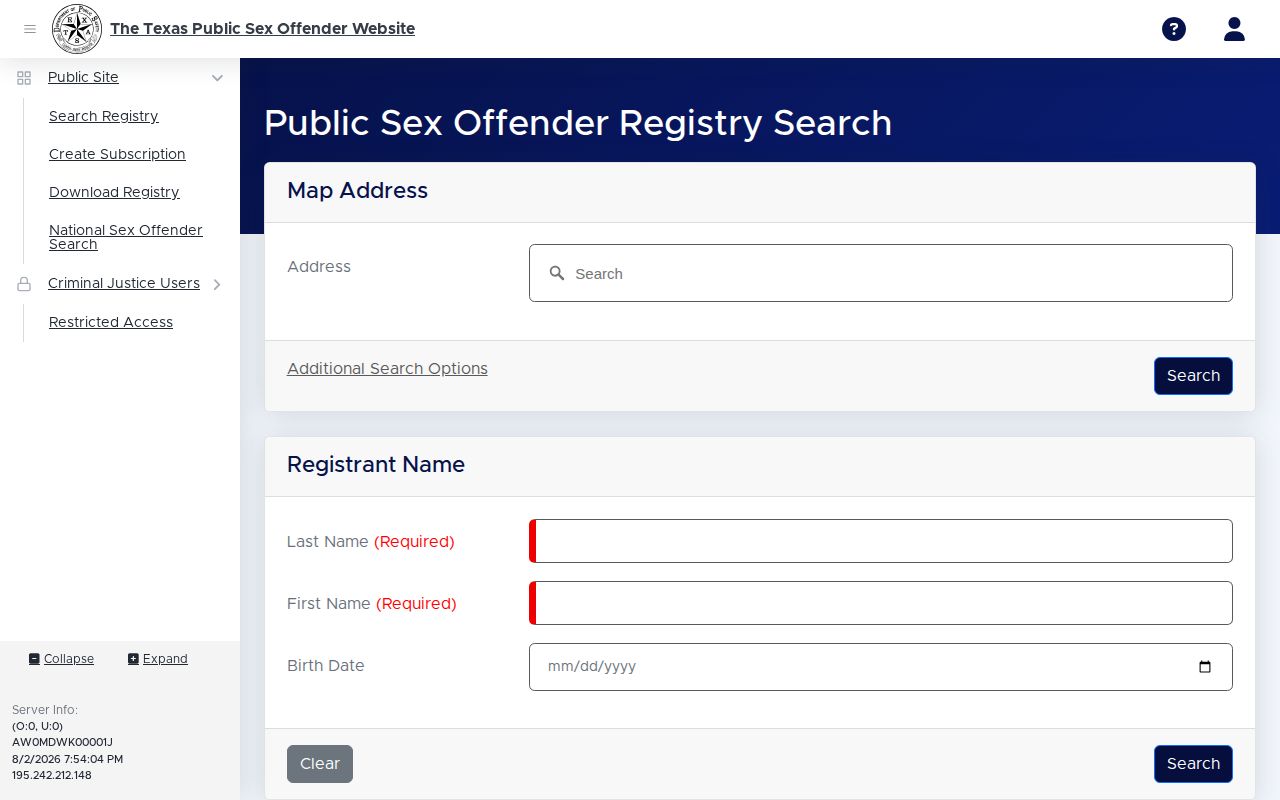
The agency source and statutory scope determine what a match means.
Request Madison County Supervision Records
A narrow request is easier for an agency to route than a broad demand for every file. For parole, identify the person with the available TDCJ number, full name, and date of birth as appropriate, then specify the existing fields needed: parole or mandatory-release date, current status, assigned office, warrant information, or discharge date. TDCJ general inmate information is available at 936-295-6371 or 800-535-0283 on weekdays from 8:00 a.m. to 5:00 p.m.; the information email is pia@tdcj.texas.gov.
For probation, begin with the cause number and sentencing court. The Madison County District Clerk at 101 W. Main Street, Room 226, handles felony district-court records and can be reached at 936-241-6212. The County Clerk at 103 W. Trinity Street, Suite 104, is the practical starting point for county-level misdemeanor records at 936-241-6210. Ask for the existing judgment, community-supervision order, modification, revocation or adjudication order, and discharge or early-discharge order that fits the question.
Texas Government Code Chapter 552 governs public-information requests, but exceptions can apply to confidential, security-sensitive, medical, juvenile, sealed, or expunged material. Ask for reasonably segregable public portions and the statutory basis for anything withheld. A supervision record can confirm a legal status; it should not be stretched into proof of a jail's exact booking-out time.